
Pickleball vs Tennis: Which Is Harder, and Which Should You Learn First?
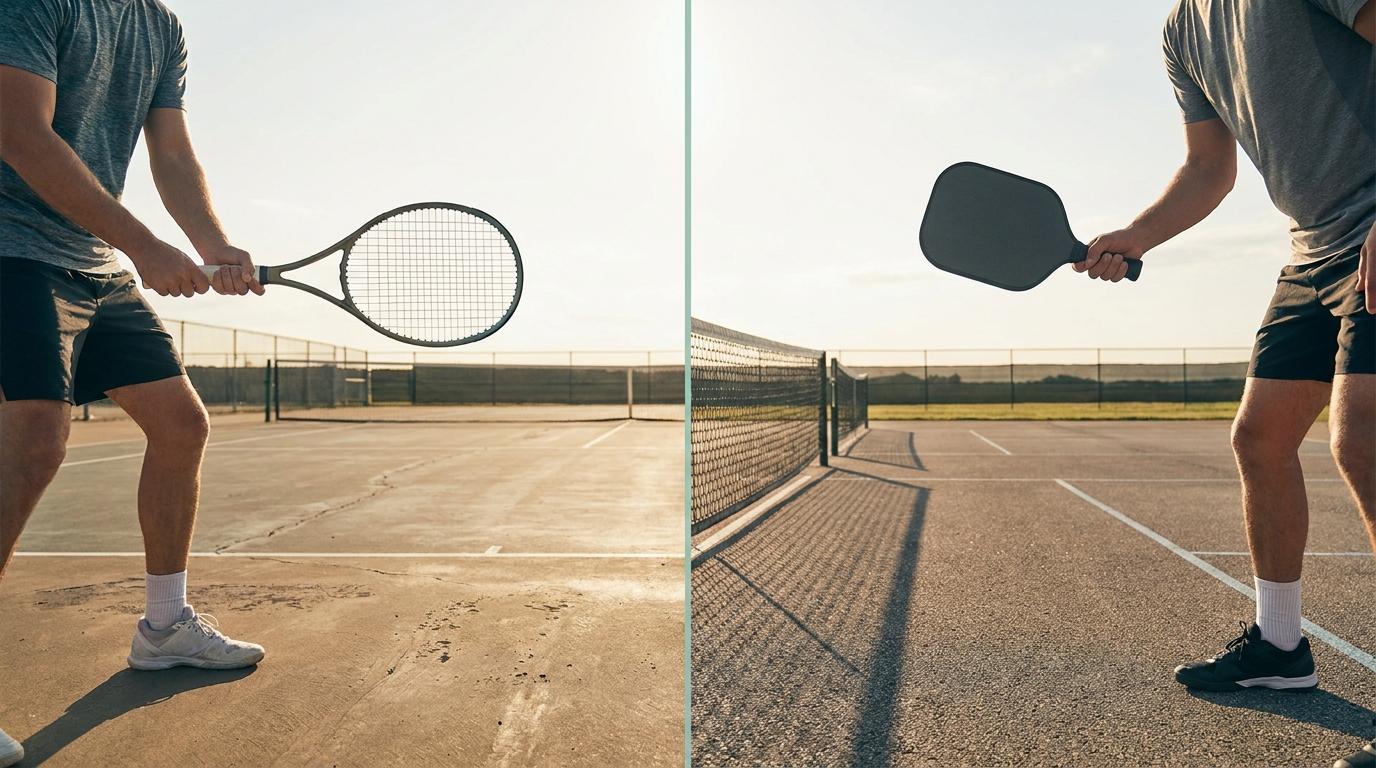
Pickleball is easier to start and harder to master than tennis. The court is about a third of the area of a tennis doubles court, the underhand serve takes minutes to learn, and rallies last longer, so beginners play real points on day one. Tennis demands more athleticism and technique; pickleball demands faster hands and sharper positioning at the net.
We are the Gawler & Barossa Pickleball Social Club, and we play on tennis courts: Essex Park with the Gawler & Districts Tennis Association on Victoria Terrace, Gawler, and Voyager Tennis at Playford, 50 Spruance Rd, Elizabeth East. So this is a question we get asked in person, usually by someone who has just walked past a game on their way to a hit.
Pickleball vs tennis at a glance
| Pickleball | Tennis | |
|---|---|---|
| Court size | 20ft by 44ft | 27ft by 78ft (singles width, the doubles court is wider) |
| Net | Lower, and set slightly lower at the centre than at the posts | Higher, and also set lower at the centre than at the posts |
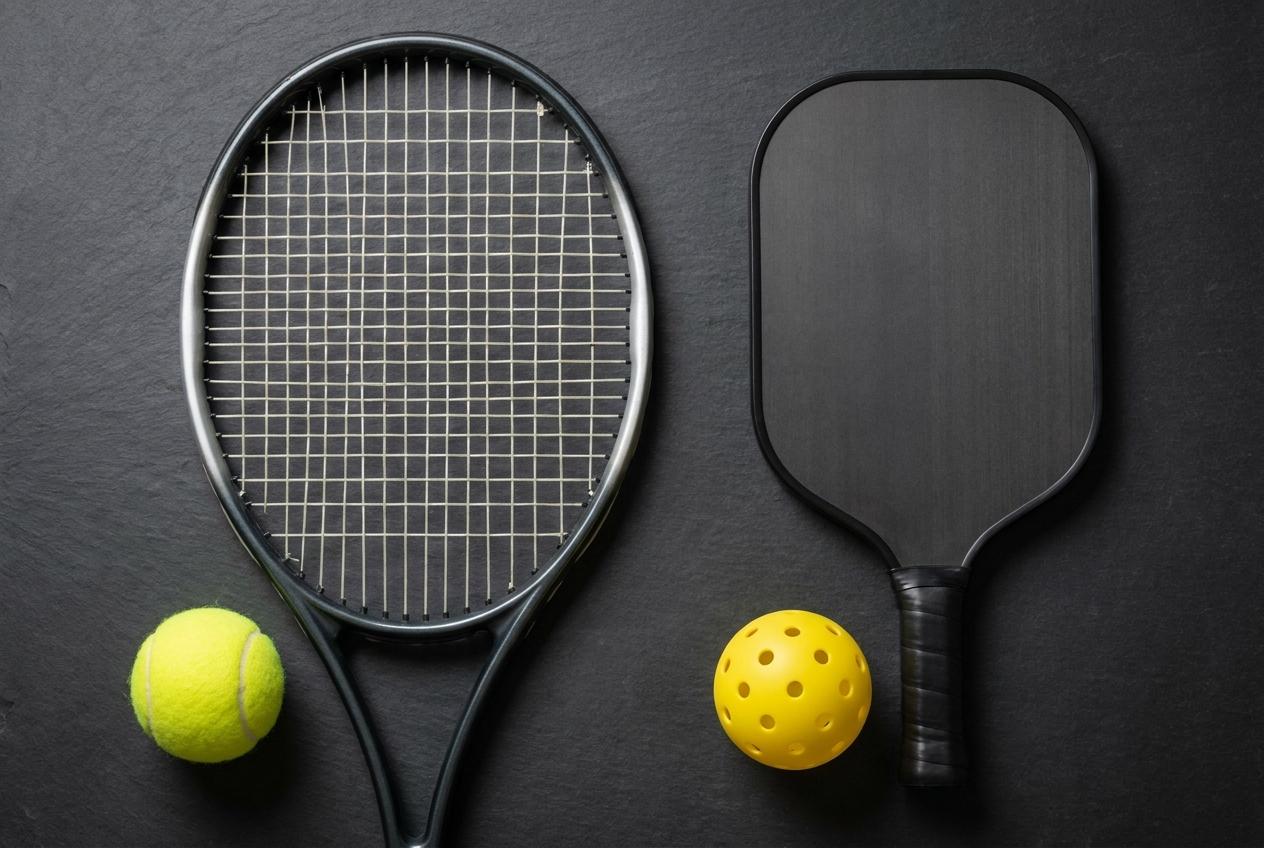
| Ball | Perforated hard plastic, no pressure, slower and lower bouncing | Pressurised felt covered, faster and livelier |
| What you hold | Solid graphite or composite paddle, short handle, no strings | Strung racquet, long handle |
| Serve | Underarm and diagonal, with contact below the waist, except the drop serve, which is not bound by that height limit | Diagonal, and usually overhead, though the rules do not require an overhead action |
| Scoring | Games normally to 11, win by two points, with 15 and 21 also used in tournaments | Points make games, games make sets, sets make the match. A game is won by two points, a set by two games, and tiebreaks settle both |
| Rally length | Longer on average, more exchanges per point | Shorter on average, more points ended early |
| Net rules | A non-volley zone (the kitchen) near the net that you cannot volley from | No equivalent zone |
The pickleball figures in that table come from the 2026 USA Pickleball Official Rulebook, Global Pickleball Federation Edition, which Pickleball Australia adopts and links from its Rules and Scoring page, so that page is where an Australian player finds it. The tennis figures come from the ITF Rules of Tennis. Check those two sources if you want the figures first hand.
The ancestry helps explain it. Pickleball borrows the court footprint and the underarm serve from badminton, the net play and paddle feel from table tennis, and the scoring logic and court sense from tennis.
Which is harder to play, pickleball or tennis?
Both, depending on which week of your life you ask.
Harder to start: tennis
Tennis asks a beginner to do several hard things before they can play a point. An overhead serve is a whole skill on its own. The court is big, the ball is fast off the bounce, and a full swing takes months to make repeatable. Most people’s first tennis session is spent chasing.
Pickleball asks much less on day one. The serve is underarm and low, the court is small enough that you can reach most balls without sprinting, the ball does not fly away from you, and the paddle needs no string tension or technique to make contact. The sport is quick to pick up, and that is most of the reason it has spread.
Harder to master: the case for pickleball
Once everyone can rally, pickleball gets very fine very quickly. The non-volley zone pushes the whole game to the net, where points are decided by touch rather than power. A dink that lands soft and low is hard to attack. A third shot drop, the soft ball you hit from the baseline to buy your way forward, takes a long time to hit reliably under pressure.
That is where tennis players often get a surprise. The physical gap that would decide a tennis point does not decide a pickleball point at the net. You can be fitter and faster and still lose a hands exchange to someone who has played twice a week for three years.
Should you learn pickleball or tennis first?
If you want to be playing points and enjoying yourself this month, start with pickleball. If you have a specific reason to play tennis, a club, a family, a junior pathway, start with tennis and learn it properly, because tennis technique is harder to acquire later and pickleball will still be there.
The two are not in competition for your weekend. Plenty of people at our venues do both, on the same courts, in the same week.
What transfers from tennis, and what actively hurts you
Footwork, court sense and hand eye: transfer well
Reading an opponent’s shape, splitting at the right moment, knowing where the open court is, watching the ball onto the face: all of that comes straight across. Tennis players usually cover the court well and rarely get surprised by pace.
The full tennis swing: the habit that costs tennis players points
The long backswing is the one that has to go. In a space this small, with a ball this slow, a full swing sends the ball long or gives your opponent the time they needed. The soft game is the harder unlearn: tennis rewards you for hitting through the ball, and pickleball will punish you for it on the first four shots of most points.
Tennis players also have to learn to move forward. In tennis the baseline is home. In pickleball the line at the edge of the non-volley zone is home, and staying back is how you lose.
How does it compare to padel and paddle tennis?
These three get mixed up constantly, and they are separate sports.
- Padel is played on an enclosed court with glass and mesh walls that are in play, like squash. The serve is underarm, the paddle is solid and perforated, and the ball is a slightly depressurised tennis ball.
- Paddle tennis, also known as POP tennis, is played on a smaller open court with no walls, using a solid paddle and a depressurised tennis ball.
- Platform tennis is a cold weather sport played on a small raised deck surrounded by screens, with the screens in play.
Pickleball is none of these. No walls, no screens, its own perforated plastic ball, and the non-volley zone that no other paddle sport has.
Which is harder is not really answerable across sports, but the honest version is that padel’s walls add a layer of reading that takes longer to learn, and pickleball’s net exchanges get faster than any of them.
Is pickleball easier on an older body than tennis?
We are not going to make a health claim here, so here is what is actually different, mechanically, and you can take it from there.
The pickleball court is roughly a third of the area of a tennis doubles court, so there is less ground to cover and less flat out sprinting. The serve is underarm, so there is no overhead serving action. The swing is short, so there is less rotation through the trunk. The ball is slower and bounces lower, so more shots are played at a comfortable height. Much of the game happens standing near the net rather than running between corners.
That is the mechanics, not a verdict. Whether any of it suits you personally depends on your body, and we are a social club, not a clinic. If you have a knee, hip, shoulder, back or heart concern, ask your GP or physio before you start, not us.
The honest downsides
- It is addictive in a way that eats your calendar. Not a joke. People arrive for one session and rearrange their week.
- It is noisy. A hard paddle on a hard plastic ball makes a distinct pop, and several courts at once are loud. This is the number one complaint from neighbours of outdoor courts worldwide.
- The soft game is frustrating at first, especially if you come in athletic and expect to dominate.
- Court availability is the real constraint, not interest. There are not many dedicated pickleball courts in South Australia, which is why the game is so often played on tennis courts shared with tennis.
- It is not a substitute for tennis if what you love about tennis is the serve, the full swing and the space.
Who should not play pickleball: anyone whose doctor has told them to avoid stop start court sport, and anyone who wants to be immediately good at something.
Is pickleball a fad? Is it losing popularity?
Fair question, and the honest answer is that we cannot give you a participation number, because we do not have one we trust.
What we can point at locally is that pickleball has reached the level where South Australian local government is writing about it. The Local Government Association’s site published “Pickleball phenomenon sweeps through SA councils”, and that article is prominent enough in South Australian pickleball search results that it is hard to miss. Councils do not write about hobbies that three people have.
Our own read, as a club rather than as analysts: the sport grew fast because it is genuinely easy to begin and genuinely social, and neither of those things expires. Whether the growth rate holds is not something we can measure or promise.
Try both at the same venue in Adelaide’s north
Here is the structural advantage of where we play: our venues are tennis venues. Essex Park in Gawler is the Gawler & Districts Tennis Association’s home. Voyager Tennis at Playford is a tennis centre. The two sports share the same courts, the same car parks and often the same people. If you are already a tennis player in the northern corridor, you almost certainly know one of these places.
There is no fixed weekly timetable. Sessions are arranged around when people are actually free, so rather than turning up at a set hour, the first step is simply to get in touch and tell us when you are usually free.
What to bring the first time: court shoes, water, and whatever you would wear to a hit. Do not buy a paddle before you have played. Ask us first about equipment when you get in touch, rather than guessing from an online list.
To get started:
- Email Jordan at jordanvonstanke@gmail.com or call 0400 651 826 with the times you are free.
- Read the welcome page if you want the short version of who we are.
- Book a court if you would rather organise your own hit first.
- If you would like a low pressure first go, see our come and try session at the GDTA Open Day.
More on the sport and the club over on the blog, or head back to the homepage for the essentials.