
Pickleball Gear for Beginners: What You Actually Need Before Your First Session
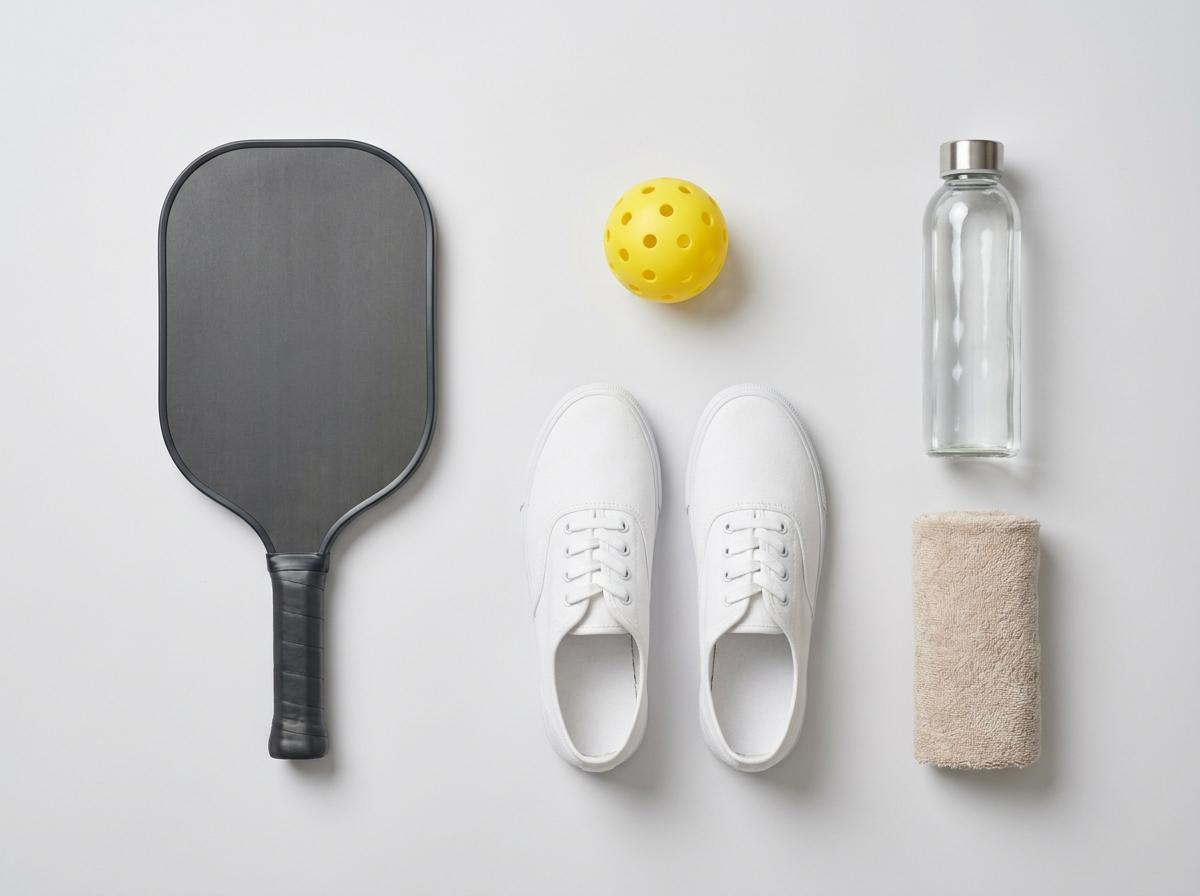
Most beginners need almost nothing to start: a paddle, whatever ball is in play on the day, and shoes with a flat, non-marking sole. Buy nothing before your first session. The one purchase worth planning for afterwards is a paddle, and the USA Pickleball rules set limits on how big a paddle can be, so it is worth a quick read of the current official rulebook before you spend anything.
What do you actually need for your first session?
Shoes you can move sideways in, clothes you can sweat in, and a water bottle. That is genuinely it for a first hit.
Everything else on this page is either shared around, borrowed, or something you can decide about later once you know whether you like the game. If you turn up with nothing but the right shoes, nobody will blink.
The paddle: sizing rules, and what actually matters when choosing one
The size limits, in plain terms
A pickleball paddle is not a free-for-all shape. Playpickleball.com, quoting the 2025 USA Pickleball rules, gives two limits: the paddle’s length cannot exceed 17 inches, and its length plus its width combined, including any edge guard and butt cap, cannot exceed 24 inches. The same source states there is no restriction on paddle thickness and no restriction on paddle weight.
We are repeating those figures from a secondary source, not from the rulebook itself, so please check the current official USA Pickleball rulebook before you rely on them. Pickleball Australia (pickleballaus.org) is the place to start for how those rules apply here. USA Pickleball also publishes a searchable approved-paddle list, which is what you would check if you ever wanted a paddle that is legal for sanctioned play rather than a social hit.
The practical upshot: almost every paddle sold as a pickleball paddle sits inside those limits, and because there is no thickness or weight rule, paddles differ enormously in feel rather than in one “correct” specification.
What to feel for, not what to buy
We are not naming brands or models, and we are not quoting prices. What is worth paying attention to when you first pick one up:
- Weight. Paddles come in a real range. A lighter paddle is quicker to move and get into position, a heavier one puts more mass behind the ball for less swing. Neither is better. One of them will suit you.
- Grip size. If the handle feels too fat or too skinny in your hand, that is a real thing, not fussiness.
- The paddle face. Different faces grip the ball differently. You will not notice this in your first month, so do not let anyone tell you it matters yet.
The best way to find out is to hold a few. Most people at a social session are happy to let you try theirs for a game.
Can you borrow one at our sessions?
We are not going to tell you either way here, because it depends on who is playing and what they have brought. Ask us first. Email jordanvonstanke@gmail.com or call 0400 651 826 and we will tell you honestly what will be there on the day. It is a thirty-second question and it saves you buying something you might not need.
The ball: why the indoor ball is a different piece of equipment
A pickleball is a hollow perforated polymer ball with circular holes punched through it. Per the USA Pickleball rules as quoted by playpickleball.com, the official hole count sits between 26 and 40, and again, check the current rulebook rather than taking our word for it.
Within that range, manufacturers build two broadly different balls. Indoor balls sit toward the low end of the hole count with larger, more widely spaced holes and softer plastic. Outdoor balls sit toward the high end with smaller holes and harder plastic, built to cut through wind. That is a manufacturing convention, not a separate rule.
Why it matters to you: almost nothing. Balls tend to be a shared, session-level item rather than something a beginner sources, but whether that is how it works at a given session is a fair question to ask rather than assume. It is worth knowing the difference only so that the outdoor-ball advice you will find in a lot of overseas content does not confuse you.
While we are on equipment that is not yours to worry about: you will notice the net sits slightly lower across the centre than it does at the sideline posts. That is normal, and someone else sets it up.
Shoes: the one thing worth getting right
Why non-marking soles matter on a court
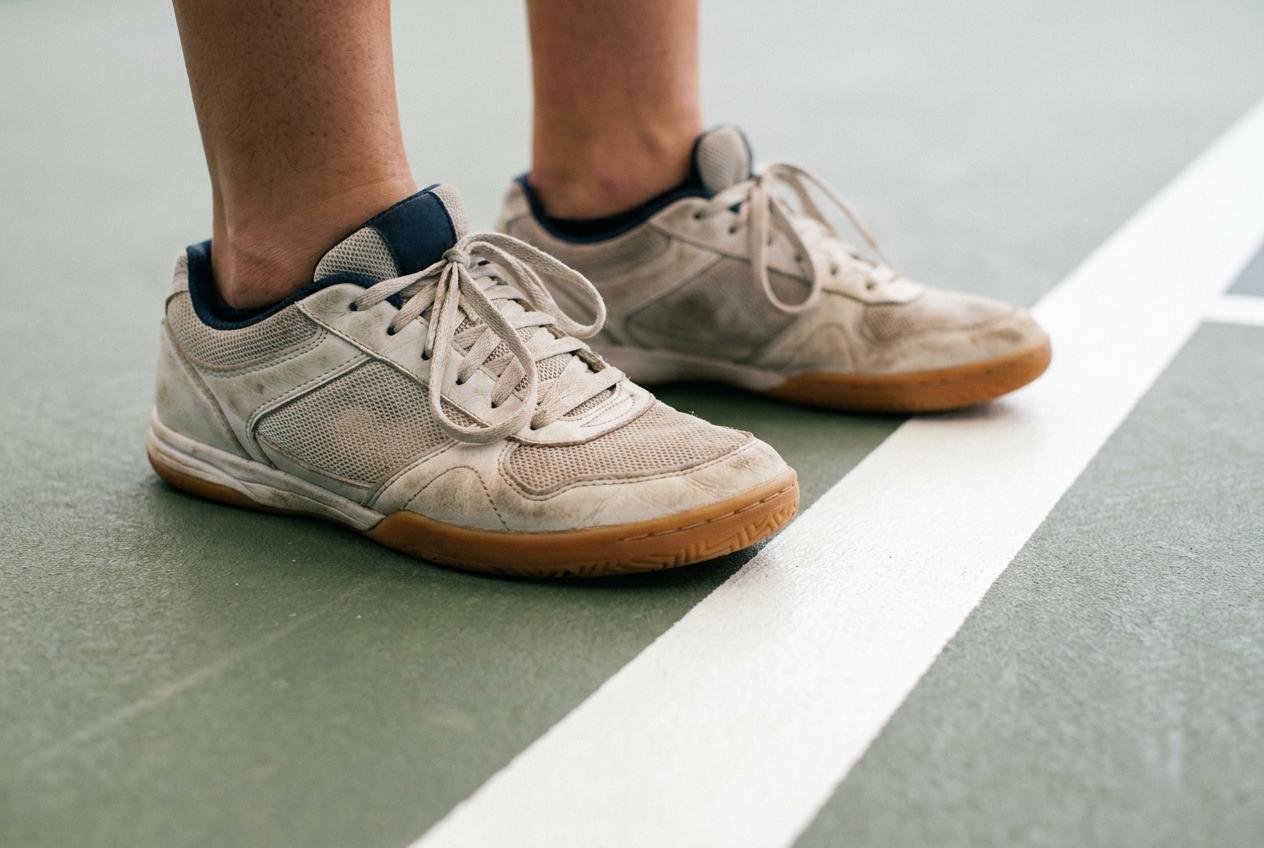
If you are playing on an indoor sports floor, that floor almost certainly requires a flat, non-marking sole, the same requirement as indoor basketball or netball. Shoes that leave black scuffs can get you sent off the court, and that is a miserable way to spend your first session. On an outdoor hard court the venue is less fussy about marks, but you still want a flat sole that grips sideways rather than a deep off-road tread.
We play at more than one venue, so which surface you end up on depends on where the session lands. Ask us, or ask the venue, before you come. If you only own one pair of sports shoes, a flat non-marking court sole is the sensible choice either way, because it works on both.
Court shoes vs running shoes vs whatever’s in the cupboard
Can you wear regular sneakers? For one cautious first session, probably, as long as the sole is flat and non-marking. But running shoes are built for forward motion, with a soft, tall heel that is designed to roll you forward. Pickleball is side to side: quick stops, small steps, sudden changes of direction. A running shoe is not built for that.
A court shoe from tennis, squash, netball or volleyball is built for that lateral movement and will do the job. If you already own a pair from another sport, you are done, do not buy anything.
There is no single “number one pickleball shoe”, and we are not going to pretend there is. If you have an existing knee, ankle or foot problem, or you want advice on what suits an older player, that is a question for a podiatrist or physio who can look at your actual feet, not for a club blog.
The full first-timer gear list, ordered by what you need first
- A paddle, but borrow before you buy. A paddle is the one piece of equipment you cannot play without, and it is also the one item we refuse to send you shopping for on day one. The size limits are the ones quoted above from the USA Pickleball rules, and beyond those there is no thickness or weight restriction, which is why paddles vary so much by feel. Ask us what is available before you turn up. Needed before session one: only if nothing can be borrowed on the day.
- The ball, and knowing it is not the same ball you would use outdoors. Indoor and outdoor balls sit at opposite ends of the official hole-count range, with different plastic to match. Needed before session one: no. Balls are usually a shared, session-level item rather than something a beginner brings, but ask rather than assume.
- Non-marking court shoes, the one purchase that actually matters. Flat, non-marking sole, built for lateral movement. Already own court shoes from another sport? They will very likely do. Needed before session one: effectively yes. Turning up in shoes with a marking sole may keep you off an indoor floor, and running shoes are built for the wrong direction on any surface.
- Comfortable, breathable sportswear. Nothing pickleball-specific. Whatever you would wear to any social sport, with room to move through the shoulders and hips. Needed before session one: what you already own is almost certainly fine.
- A water bottle. You will sweat more than you expect. Needed before session one: yes, though it is common sense rather than gear.
- A hand towel. Small, easy to forget, useful for wiping your hands and your grip between points. Needed before session one: optional comfort item.
- Grip or overgrip tape, only once you own a paddle. A handle slick with sweat is a genuine control issue, and replacing worn grip tape is normal maintenance. No relevance at all while you are borrowing. Needed before session one: no.
- Protective eyewear, optional, more relevant in doubles. At the net in doubles the ball travels fast in a small space. Plenty of players never wear eye protection, some choose to, particularly if they already wear prescription or sport glasses. We have no injury data to make this a requirement, so we present it as a personal choice. Needed before session one: no.
- A paddle cover or simple bag, once you own a paddle worth protecting. A paddle face can be scuffed by a hard surface or by other paddles rattling around loose in a sports bag. Irrelevant while borrowing. Needed before session one: no.
- Compression or joint support gear, optional. Ankle, knee or elbow supports are a comfort and confidence choice for some players, especially those coming back to a racquet or paddle sport after time away. This is not a health claim. Anyone with a specific joint concern should ask a GP or physio, not a gear list. Needed before session one: no.
- Extra balls, not a beginner’s job to source. Regular players often bring spares between them. Whether that is how it works at a given session is a fair question to ask rather than assume. Needed before session one: no. Ask when you arrive.
- Surface-specific extras, only once you know which surface you are on. Buying your own outdoor ball, a hat, sunglasses or sunscreen only makes sense if you already know you are playing outside, and a heavy outdoor tread only makes sense outdoors. A lot of gear content online assumes outdoor asphalt by default. Find out where the session is first. Needed before session one: no.
What you can skip entirely for your first few sessions
Items 6 through 12 above. All of them. Grip tape, eyewear, paddle covers, joint supports, spare balls and every piece of surface-specific gear are things you can decide about after you have played, if you decide anything at all.
Items 1 and 2 are worth a quick question to us rather than a purchase, which leaves you with exactly three things to sort out before you arrive: shoes, clothes and water. That is the “almost nothing” promise at the top of this page, delivered.
Bring this, not that: local advice
A great deal of pickleball gear writing is American and outdoor by default. If you read it and take it literally, you will end up buying a ball you do not need and shoes with tread built for asphalt.
For a first session with us in Gawler or the northern Adelaide corridor: flat non-marking soles, comfortable clothes, water. That combination works indoors or out, which is why we suggest it. The rest depends on the surface, so ask us or ask the venue which one you will be on before you buy anything for it.
And if you live out in the Barossa, none of this changes. Same gear, slightly longer drive. We play in Gawler and at Playford, so the gear question is the same wherever in South Australia you are travelling from.
Come and play before you buy anything
We are a social club and our sessions are arranged around when people are actually free, not on a fixed weekly timetable. So the call to action here is not “be at the courts on Tuesday”, it is: tell us when you are free and we will tell you where the next hit is.
Email jordanvonstanke@gmail.com or call 0400 651 826. Ask about paddles while you are at it.
If you want a look at the rest of the club first, the homepage has where we play and how to find us, the welcome page covers what a first session is like, and you can book a court if you would rather organise your own hit and bring whatever you have already got. There is also our come and try day write-up, and all posts if you would like to keep reading.